.png)


SCHIZOPHRENIA
Drug Treatment in Schizophrenia:
Neuroleptics (antipsychotics) aim to normalize distorted thoughts in schizophrenic patients with psychotic disorders by increasing alpha activity and decreasing beta activity (Niedermeyer E, 1987; Herrmann WM, Schaerer E, 1986).
https://www.instagram.com/p/C2SYVHvoc8X/?hl=tr
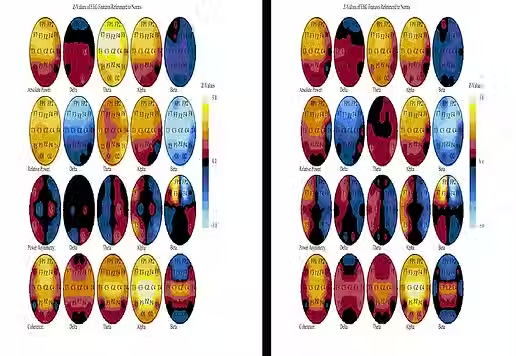
Neurofeedback Therapy in Schizophrenia
A study by Schneider and Pope (1982) investigated the possibility of replicating the EEG changes caused by neuroleptics in remission using EEG feedback techniques. Nine schizophrenic patients participated in the study. Over five sessions, each patient was continuously given feedback on changes in their own power spectrum profile compared to power spectrum profiles associated with the remission effect of neuroleptics found in previous research. Significant intra-session changes were observed in two of the three power spectrum bands studied. However, no EEG changes were observed between sessions.
These results demonstrate that by applying feedback techniques, the EEGs of schizophrenics can temporarily produce changes that mimic the remission effect of neuroleptics.
Slow cortical potentials (SCPs) are thought to reflect the attentional resources and cortical excitability regulations of cortical neuronal networks. Impaired attention functions, which are seen in schizophrenic patients, may be associated with impaired Slow Cortical Potential regulation. Controlled neurofeedback studies with slow cortical potential have shown increased cognitive function in schizophrenics (Schneider, F. et al, 1992; Gruzelier J. et al, 1999; Hardman E, 1997).
Some published research involves fMRI NF and other types of NF in clinical applications. For example, in a pilot study of NF using real-time functional magnetic resonance imaging by Ruiz et al. (2013), schizophrenic patients trained the right insula to self-activate, which improved the facial recognition function it is responsible for.
Another fMRI NF study involved 11 schizophrenic patients and 11 healthy control subjects learning to control the ACC, but doing so through different neuronal pathways. Schizophrenics activated the dorsal subunit, while the healthy group activated the rostral subunit. Schizophrenics can learn to regulate a localized area. (Cordes JS. et al, 2015)
Although neurofeedback has been studied in detail in various diseases, there are only a few uncontrolled case studies investigating its clinical effects in the treatment of schizophrenia.
In the article by Sürmeli et al. (2012), neurofeedback treatment was applied to a group of 51 schizophrenic patients. In this study, those with a total PANNS (Positive and Negative Symptom Scale) score above 70 were included. (Range: 76-156; 70-79: 2 participants; 80-89: 9 participants; 90-99: 8 participants; 100-109: 5 participants; 110-119: 9 participants; 120-129: 5 participants; 130-139: 5 participants; and above 140: 5 participants).
According to the results, 47 out of 48 participants showed clinical improvement after NF treatment, according to their PANSS scores. The mean score of the group, 110.24 (±21.62 std), decreased to 19.56 (±26.78). This change was found to be statistically significant. Those who could take the MMPI and TOVA tests also showed a significant decrease in these scales. At the end of treatment, 40 participants were followed for more than 22 months; two for 1 year, one for 9 months, and three for 1 to 3 months. The mean decrease in PANSS scores was 83% (± 23%), which was greater than the 20% decrease seen in studies using only antipsychotic medication. In the study, 94% of participants adhered to and were consistent with NF treatment, and of those who needed medication, 68% adhered to their medication regimen for up to two years of follow-up. In the Clinical Antipsychotic Trials for Interventions Effectiveness (CATIE), the effect of medication on the primary scale (participants' adherence to the study) was only 26%. (Lieberman JA. et al, 2005; Kane JM, 2006; Janicak PG., 2006)
When reading scientific publications detailing the effectiveness of various treatments applied to schizophrenic patients, it may be helpful to learn about the assessment scales they use. The PANSS scale is commonly used in registration trials of new antipsychotic drugs. (Kay SR. et al, 1987)
Clinical trials investigating the acute efficacy of antipsychotics generally use a threshold for inclusion, e.g., a total PANSS score of at least 70 or 80 (but sometimes lower thresholds are used). It has generally been observed that the average pre-treatment PANSS total score of participants in acute schizophrenia studies is around 90 (plus or minus 10 points). A PANSS total score above 120 is considered too high and would most likely not be eligible for participation in a placebo-controlled monotherapy clinical trial. While the mean change in PANSS score is often the primary outcome measure in registered studies, sometimes knowing how many patients have achieved a certain degree of improvement can be clinically useful. A “respondent analysis” can be helpful in providing this information.
The doctor and the physician should know what percentage of patients showed a certain reduction in their psychopathology, for example, 20% (understandable), 30% (slight improvement), or 40% (possibly strong improvement). [In another example], it may be important to know that in a clinical study, 45% of patients "responded" to an "antipsychotic," compared to a 15% response rate for the placebo. This 30% difference in response rate can be attributed to the effect of the medication. (Citrome L. 2007; 2008)
Bolea AS. (2010) showed that in a clinical NF study, 70 chronic schizophrenic patients who had been hospitalized for more than 20 years showed improvement in their symptoms and neuropsychological tests after an average of 130 sessions. Participants were discharged to an assisted living program, and improvements lasted for 2 years.
After 272 neurofeedback sessions, a 21-year-old schizophrenic university student showed clinical improvement, his Aripiprazole dose was reduced from 20 mg to 7.5 mg, and he was able to return to university. He was doing well during a 6-month follow-up. His psychosis returned when he stopped the medication again. (Schummer GJ & von Stietz J., 2013)
There is also a controlled case study (Cortoos A. et al, 2006) showing that neurofeedback therapy is effective in treating sleep disorders in chronic schizophrenia.


Evidence-Based Medicine: Neurofeedback Treatment in Schizophrenia:
Biofeedback treatment methods used in schizophrenia are most likely between “possibly effective” and “probably effective.” These limits are outlined in the guidelines prepared jointly by the Association for Applied Psychophysiology and Biofeedback (AAPB) and the International Society for Neurofeedback and Research (ISNR). (See Table 1 for summaries of these limits). (La Vaque TJ, 2002)
You can read more extensively about the feasibility and positive effects of biofeedback/neurofeedback in schizophrenia in my contribution to the book I wrote for Elsevier publishing house, Chapter 10, under the title Treating Thought Disorders.